Tuesday, 9 September 2014

Weekends That Were - September 2014

28.9.14

Lindum, Fuller & Sandy Camp

Headed out alone to check on the wetlands – good numbers of birds and I added a few commoner ones to my site list at Lindum, but nothing to ‘write home’ about. A party of 18 Sharp-tailed Sandpipers deserved, and got, intimate and extended ‘scope attention in the hopes of something more exotic, but they remained Sharpies despite my best attempts to convert them….
A few Red-necked Avocets (11), Red-kneed Dotterels (also 11) and a single Marsh Sandpiper were still on location.
On to Fuller – and the water level had dropped slightly but it is still quite full. 6 Black-fronted Dotterels scurried around on the mud, but little else of note.
Sandy Camp was quiet. A total of 3 Glossy Ibis was nice with the other usual water birds in small numbers (9 Wandering Whistle-ducks). There were no other birders there so I had the place more or less to myself. Again, nothing of huge interest, although conditions were perfect for a wagtail or a vagrant fresh water wader just looking for somewhere to hole up…
Spent a little time trying to get photos of a pair of Leaden Flycatchers who responded well to playback – they move so fast and were so constantly in motion it wasn’t very successful.

The warm weather started to kick in around 9.00 and I headed home.

Male Leaden Flycatcher 

27.9.14

Murphy's Creek & Lockyer Valley

Rob picked me up at 4.40 and we had breakfast in MacD’s at Gatton while we waited for Roger (and his wife, Megan) to arrive. We then convoyed out to Murphy’s Creek and took a side road up into the hills. A washed out, rocky, vertical section of road stopped Rob’s Suzuki, so we travelled on further in Roger’s twin cab utility.
We walked tracks through the woods along the ridge line looking for Button quails, but without success. We did see heaps of Yellow-tufted Honeyeaters, Leaden Flycatchers, a party of Buff-rumped Thornbills and heard a Spotted Quailthrush. We also had a Koala and a Green Tree Snake.

We headed back down into the Lockyer, seeing a number of Black Kites and a single Peregrine Falcon over the road, and stopped off at Janke’s lagoon. The heat haze made scoping difficult, but there were a couple of Yellow-billed Spoonbills, Pink-eared Duck, Whiskered and Gull-billed Tern and 3 Sharp-tailed Sandpipers. We drove slowly along roads past 7 Mile (completely dry) and towards Atkinson looking for Ground Cuckoo-shrikes, again unsuccessfully. We did find one Banded Lapwing, hunkered down alone, in the usual field. Rob dropped me home around 14.30.

23.9.14

Linkman


20.9.14

Trotter


We were pleased to see the water level of the dam was still very low as we headed for the entrance track. We have had a little rain in the last couple of weeks and are unsure how, if any, water gets into the dam – apart from natural run off. Its really important for the level to get as low as possible – from our point of view anyway, bugger the people of Redlands shire…..
Parked up and walked the track to the water’s edge. As usual there was little activity in the woodland itself. A pair of Leaden Flys attracted attention via Mr D’s ears and a couple of Peaceful Doves called persistently.
Coming out on the open mud we set up scopes and scanned the water and banks – White-faced Herons and Masked Lapwings were immediately obvious, Great and Little Black and, later, a couple of Little Pied and Pied, Cormorants.  A single Little Egret, Eurasian Coot and a couple of Australian Grebes, small flocks of Hardheads, a few Australian Darters and groups of Australian Pelicans – the latter totalling 92 which is a very high number for ‘suburban’ Brisbane. Whistling Kites cruised overhead and above the forested edges – we counted approx 10 birds within eyesight, possibly more, and 1 adult White-bellied Sea Eagle perched up in a dead tree. A Caspian Tern flew past followed by a Gull-billed a few minutes later and, after that, five Whiskered Terns – always nice to see their relatively dainty flight on inland waters. One of them raised our interest as it had no black on the belly and a much whiter head. It also appeared to have a different jizz in terms of wing movement and flight. However, reviewing photos of immature Whiskered it appears that was what it was.
We walked the edges of the lake stopping now and again to scope. Turning the corner we headed up a side ‘channel’ and disturbed a White-necked Heron and 2 Royal Spoonbills – the Heron was a new bird for site for me – and then Mr D called a Tawny Grassbird ‘chucking’ from a stranded reed bed – another new site bird while distantly and unseen our first Channel-billed Cuckoo of the season called. Also distantly floating and soaring – a pair of Wedge-tailed Eagles.
Heading back into the woods we re-found the track and walked slowly back towards the car. A calling Speckled Warbler gave itself up very quickly to playback and we added Scarlet Honeyeater, Striated Pardalote, Eastern Yellow Robin, Spangled Drongo, Golden Whistler and Yellow-faced Honeyeater to our day list making a total of 52 species….one of the biggest day lists I have had for Trotter.

I drove us back to Belesis once again where the waitress almost rolled her eyes and said ‘not you again’ – Mr D once again plumped for the pancakes while I satisfied my breakfast need with soft poached eggs and crispy bacon.

18.9.14

Holland Park (home)


Today when I got home 2 Kookaburras chose my TV aerial to tell the world....


13.9.14

Minnippi & Lindum


Parked up at Stu’s and we went in his car to Minnippi for 6.45. Walked the usual tracks and round the lake – nothing out of the ordinary apart from exceptionally close views of a Koala hanging, for some reason, in a stumpy tree beside the river. Not the normal view one expects, as they are usually asleep high in the fork of a gum showing little interest in their surrounds.

Koala

Most exciting bird? 13 Wandering Whistle Ducks was a good number for the site and a nice pair of Leaden Flys down the airfield track attracted Stu’s attention with their raspy calls – I, of course, couldn’t hear trhem….. We noted the almost complete lack of Yellow-faced Honeyeaters and Grey Fantails – one of each – as Spring has sprung and they have mostly returned to their summer breeding grounds. A soaring Brown Goshawk and a direct flying Collared Sparrowhawk completed the raptor list for the site.
On to Lindum and hopes were high for a decent wader – it was not to be. The same 4 Marsh Sands, 6 Red-necked Avocets and the usual 70+ White-headed Stilts wandered the mud. There were no ‘brown’ waders – it being low tide at the time of our visit possibly they were feeding out on the bay? The water level was exactly the same as last weekend so it would appear not to be tidal – even though Mangroves are a main feature of the water’s edge. Possibly at very high tides it gets an overflow from the incoming tide?
I had looked over the general area during the week on Google maps and had identified another apparent wet area on the opposite side of the road. I suggested to Stu we should explore there and so we did.
Easy access, it being council land – unfortunately the open muddy pool brimming with rare waders that I had imagined didn’t eventuate…..a patch of dense bush surrounding an overgrown, reed filled hollow was what we found and, while it may have some potential, it would be unlikely to hide a first Australian….
We did find a colony of Grey-headed Flying Foxes with approx. 100 animals fluttering and calling nervously through the canopy as we approached. Their behaviour made me wonder if they are experiencing regular disturbance by local residents as the park is surrounded by residential development and the knowledge that flying foxes carry the Hendra Virus that may be transmitted to horses has resulted in some over reaction by some elements of the Queensland community. They seemed unusually active and concerned for such an early hour – there was, however, no evidence to suggest anything illegal had taken place.

We also had a nice Olive-backed Oriole and another pair of Leaden Flys before heading off, once again, to Belesis’s for pancakes for me and eggs and bacon for Stu and the usual 2 ‘volcanic’ coffees which, this week, they managed to achieve successfully.
6.9.14

Lindum, Fuller & Sandy Camp

Rob’s turn to drive and he picked me up at 6.00. Arriving at Lindum we first turned down Burnby Rd and scanned the back part of the shallow water mud hole from the road (I had my scope, Rob had forgotten his). Just a few Stilts and 1 Sharp-tailed Sand in view, however, a few small birds flitting around the trees outside the bio-research gateway led us down the road and, eventually, down a grassy ride to another patch of mud and water. Here, to our surprise, Rob identified a large brown bird as a Brown Songlark. This is an unusual bird for the Brisbane area – the closest record to the coast we have seen. There was no chance of photos as it bounced into the long tussocky grass and disappeared. A pair of Forest Kingfishers newly arrived back from up north after their winter holiday perched up on overhead wires, Mangrove Gerygone, Tawny Grassbird, Golden-headed Cisticola and Rufous Whistler also made up our day list.
Back to the car and round to the main road where we clambered over the fence and walked out onto the grass peninsula to scan the mud/water from this new angle. 6 Red-necked Avocets were mostly standing sleeping on single legs with bills turned into their backs. 5 Marsh Sandpipers huddled together behind a small grassy clump while the usual White-headed (as they are now known) Stilts, Grey Teal and a handful of Red-kneed Dotterels wandered around in their respective feeding/sleeping attitudes.
Marsh Sandpipers

Red-neckd Avocets
A couple of apparent Sharp-tailed Sandpipers wandered out of a clump of mangroves to our right and waded knee deep across open water until they reached the opposite bank and picked their way through the mangrove roots looking for titbits. In the ‘scope one of them looked a little different but it took a few minutes before it re-appeared in the open and we confirmed it as a Wood Sandpiper. This is a really good bird for Brisbane. (There was one reported from the northside in March this year and the only other ones I know of were 2 in December 2007 in nearby wetlands at Fuller Oval.) It picked its way out into the water and slowly headed off to our right and out of sight among the mangroves. We took a heap of pictures but the light and distance were against us……
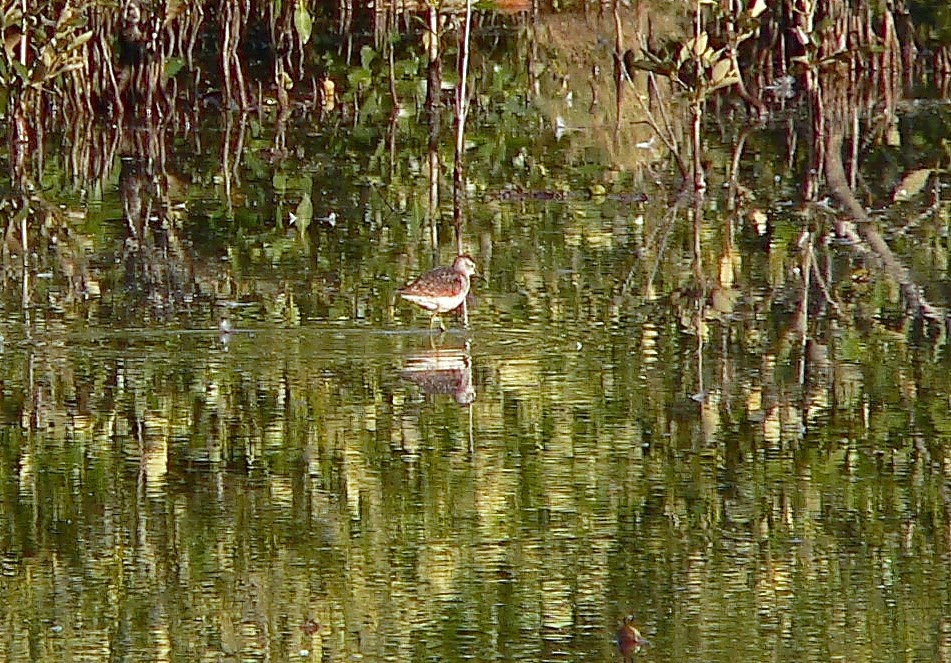


Headed on to Fuller – to find the water level surprisingly high and very few birds present. Didn’t spend a lot of time there – on to Sandy Camp.
Usual birds on the first pond – including at least 28 Wandering Whistle Ducks, another single Forest King, 3 Leaden Flycatchers, a heap of Comb-crested Jacanas, 1 Glossy Ibis and Striped Honeyeaters seemed to be singing everywhere. Rob spotted a Black Kite over the main track – a new site bird for us both and always a good bird in the Brisbane area. We checked out all the ponds but saw nothing unusual in any of them until we came around to the deep pond that usually has nothing on it and found a Spectacled Monarch and a Rufous Fantail in the same tree! Two more new ‘site’ birds. Excellent!
Australian Figbird (male)

Black Kite

Belesis again and celebratory pancakes for Rob and the usual bacon and eggs for me, along with two cups of volcanic coffee each before heading home and on to other things for the rest of the weekend.

(Footnote: to date (Tuesday) the Wood Sandpiper had not been seen again despite several other birders seeking it out)

Tuesday, 12 August 2014

Weekends That Were - August 2014


29.8.14 - 1.9.14
Tasmania


We had waited so long to get tickets that I ended up paying only $25 + 27,000 points return, but with a stopover in Melbourne on the way down, while Stu flew direct to Hobart. (We both got on the same return direct flight on the Monday). That meant I left Brisbane at 7.00, scheduled to arr Hobart at 12.00, while Stu left at 10.00, scheduled to arr at 13.00. We were car sharing with Andrew Sunderland, Nikolas and Raja – they were arriving at different times during the morning and we planned to meet up in the airport.

My flight on Friday was delayed landing at Melbourne due to fog, circled for 30 minutes, then delayed departure for Hobart by an extra hour, finally arriving in Hobart at 13.00 to meet Stu, Nikolas, Raja & Andrew. Headed off towards Eaglehawk Neck stopping to look, unsuccessfully, for Blue-winged Parrots en route. Checked into the Lufra Hotel in a room for 4 - with a double bed in one room (we let Rob Hinson have that as he’d booked the room originally) and, in the other room, a single bed – Stu – a single bunk (Dave) over a three quarter bed (mine). Both the latter contained in a very squeaky metal frame that ensured neither Dave nor I had any dirty thoughts during the night.
Dinner in the hotel, then a beer or two before crashing early-ish. Up at 6.00, on the dock at 7.00 and out on the briny in the Pauletta by 7.45.
Very light winds, fairly calm seas, nothing much until we reached the shelf around 9.30 (?) Then the usual Shy Albatrosses, heaps of Wandering of different ages, a couple of Northern Royals and a scattering of Prions - which all appeared to be Fairy, although later analysis of the photos showed at least one Antarctic was present – very frustrating. A couple of Campbell and a single Black-browed Albert, two (early) White-chinned Petrels, a single, brief Sooty Shearwater, a few Grey-backed Stormies and, eventually, one of the target birds – a single Blue Petrel. Rather like an oversize Prion, acting like a Storm Petrel. Everyone (even me) managed to get photos of it as it presented itself very well several times around the boat and in the slick.
Blue Petrel 1

Blue Petrel 2

Blue Petrel 3

Blue Petrel 4
Shy Albatross 1

Shy Albatross 2
Longish video - Adult and juvenile Wandering Albatross and Cape Petrels


We started heading back around 1.30 probably? and by this time the wind had blown up – a north westerly was pushing waves against the starboard and everyone huddled for shelter behind the relatively effective plastic side panels. I stuck it for about an hour (and got an Australian tick in the form of a White-fronted Tern we passed) and then brought up the little that was in my stomach and felt miserable for the rest of the trip. So much so that I chose not to go on Sunday and spent most of the rest of Saturday lying down in the hotel room. Bummer. I didn’t even have dinner on Saturday night.
Sunday and the boys (and girls) all took off at 6.30. I hung out for a while, had a $10 continental breakfast in the hotel then headed off for a walk up the road. Saw a few of the endemics – Yellow Wattlebird, Green Rosella, Strong-billed Honeyeaters, Tasmanian Thornbill - along with Scarlet Robins, Blackbirds etc. When the boat came back in the afternoon I was relieved that they hadn’t actually seen anything ‘new’ so I didn’t miss out on any megas.

Sunday evening saw us head off to Tarana State Forest and Black-headed Honeyeaters, Cape Barren Geese (and chicks), a couple of Australian Shelducks, Golden Whistler and a single male Pink Robin. On to the Port Arthur settlement and access gained to look for the Masked Owl – which unfortunately didn’t appear – my second time unlucky. We did nearly kill a Tasmanian Boobook on the return trip but he managed to avoid hitting our windscreen and perched up, slightly shaken, on a roadside stump while the slightly shaken occupants of the car tried to take slightly shaky photos. This is a recent split per IOC so is potentially a new tick…..
Arriving back at the Lufra we had a meal and then decided we’d go looking for a ‘large dark owl’ that the deckie of the Pauletta had reported seeing in a car park near the boat harbour a few nights previously. Piling into two cars we set off and, shortly after leaving the main road, as we headed towards the harbour, Andrew braked to avoid a couple of Little Penguins crossing the road. We watched them scuttle into a drainpipe where they squealed and grunted like a pair of tiny pigs. Further on Nikolas called another screaming halt – well, we were doing all of 10 kms an hour – and we spotlit an Eastern Barred Bandicoot  - which was pretty cool, although he looked like he’d had a run in with a lawnmower and got away with just his ass clipped. Really strange looking hair style. We saw several more along the sides of the road until they became ‘just another barred bandicoot’………. No luck with the owl so we headed for the high ground above the Lufra where I had walked earlier in the day. No further birds or owls – just a couple of Bennet’s (or Red-necked Wallabies) and a brief glimpse of a Common Wombat walking off into the bush. Crashed late.

Monday and we checked out at 7 and Stu and I headed back to Hobart with Andrew driving followed by Plaxy in her hire car. We dropped her car off at the airport and then we all set off towards Kettering to investigate a site on aboriginal land where a couple of Lewin’s Rails had been seen. Pink and Flame Robins had been promised, along with Firetails. We saw none of the above. It was a bit of a waste of time actually, but filled in the morning quite comfortably. Back to the airport by 11.45, Andrew got us through Priority Booking due to his influence - and into the first seat in tourist where we had more leg room than I could use. Landed back in Brisbane at 16.10 without any further excitement and Stu dropped me home.

24.8.14


No birding this weekend - for the first time in...... I can't remember how long. Had a tough week cycling home against very determined winds. Saturday morning woke up to drizzling rain, rolled over and went back to sleep. The rain continued most of the day, and I had other plans for Sunday.
Spent some time with Linkman - oh and Kara and Jade....


16.8.14
Trotter


Rain was predicted but we decided to get out anyway. When we arrived at Trotter it was spitting, but we had our wet gear and headed off down the track. It’s a 15 minute walk through the bush to get to the lake’s edge. Mainly eucalypt with an understorey varying from open grass to bottlebrush – unusual in the area, but the very sandy soil provides the right conditions. Despite the apparent attractiveness of the vegetation - it looks perfect – there is never a lot of bird activity and this morning was no exception. Apart from a couple of distant calling Yellow-faced Honeyeaters and a Grey Shrike Thrush and nearby Kookaburras challenging each other there was really little else. Rob also saw an Eastern Yellow Robin fly up off the path and as we neared the shore line we could hear a very distant Striped Honeyeater.
For the last 10 or 12 years the water levels have been high – right up to the tree line. The water bird activity had been very low, due, I believe, to the depth of the water. Early in the 2000s the water level had been very low - the lake almost dry - and at that time I had added numerous waders and duck to my site list. It appeared this was re-occurring now – there was a wide expanse of drying mud out to a relatively narrow channel of water. Not yet as low as it got years ago but if it stays like this for a few weeks the potential could be enormous.
A flock of Eurasian Coots paddled across the channel ‘up’ river while two large flocks totalling approx. 60 Hardheads bobbed in the increasing rain and 2 Whistling Kites drifted quietly past. Several Australian Grebes, a variety of Cormorants, a couple of White-faced Herons, 2 Royal Spoonbills and a Great Egret completed the initial scene. We moved along the edge of the tree line trying to avoid the rain as much as possible, but it just got worse. Turning away from the lake under the power lines we sheltered for a few minutes under a small roofed information stand until the rain eased off somewhat, then we trudged on. Rob suggested diverting to an inlet of the lake showing through the trees to our left and, as he was wetter than I, I agreed and we found 3 Yellow-billed Spoonbill, 2 Grey Teal and an adult White-bellied Sea Eagle to add to our day list.
Arriving back at the car 20 minutes or so later we had added little extra and the rain was persisting so we headed off for breakfast at, once again, Belesis so, once again, Rob could satisfy his passion for pancakes. Their bacon and eggs is a really good deal as well and the coffee was fine!
                                                                                                                                    
13.8.14
North Stradbroke Island


Ekka Day - the day SE Qld shuts down so 'the people' can go to the Exhibition and get ripped off. I chose to go to North Stradbroke Island and make the most of the bright sunny day with the 20 knot south easterly wind.
Left home 6.15, water taxi left at 6.55, the bus picked me up at Dunwich on the island at 7.30.  Spotted the usual Bush Stone Curlews standing motionless in the bush along the roadside from the hurtling bus.Walked the 300 metres to Pt Lookout and settled down in my camp chair at 7.55.  
The first hour was pretty good - about 150 Fluttering Shearwaters hammered past heading south into the wind, a handful of Wedge-tailed a little further out made more hard work against the wind and a smaller handful of Australian Gannets (mostly adult) also drifted southwards. 
After 9.00 numbers dropped dramatically - less than 10 Fluttering, a few more Wedgies and about the same number of Gannets. 
The number of Hump-back Whales however was good with adults tail slapping and, occasionally, breeching. One juvenile half breeched a few times close to the headland, I thought it was a Minkie at first, but a large, presumably female, Hump-back in close proximity clarified the situation. The usual horde of civilians oohing and aching at their antics persisted most of the morning, asking the usual questions.
I took some video of the headland - all the birds and whales were too far away for any photos. I don't know who the old couple are - they were just there.

 I gave it away at 10.30 when the numbers of passng birds had dropped almost to zilch - apart, that is, from the usual Great Crested Terns which are always there in good numbers. One Gull-billed Tern was the only other noteworthy species (they are not common on the exposed seaward side of the island, being more a quiet water, even inland lake, type of bird)
Back at the water taxi terminal in Dunwich it was high tide and the usual Pied Oystercatchers, Caspian and Gull-billed Terns loafed on the beach. A single Lesser Crested Tern hid out in the centre of the group.

10.8.14
Oxley

Sunday morning and I headed for Oxley. A calm misty morning again and loads of Scarlet Honeyeaters again feeding and singing. I managed to pull 4 Eastern Spinebills in with playback and tried for photos but they were too quick. The ponds had re-filled apparently from a short rain storm we had had a few days ago. The duck numbers were still surprisingly low given the time of year and nothing unusual popped up.  I did manage to get a couple of average shots of a Laughing Kookaburra who was very focused on catching something in the grass.


9.8.14 - PM
Phascogales and Owls

An offer had been made to visit a private property near Samford village, 45 minutes north of home to see Brush-tailed Phascogales and Rob and I had jumped at the chance. 
Phascogales are (to quote Menkhorst & Knight's Mammals of Australia) 'rat sized, sharp-nosed hunters' and are 'generally rare and threatened by habitat fragmentation'. The opportunity to see these animals was a rare opportunity. As it turned out the Phas in this case had invaded the owner's house and he was trying to gently urge them to live elsewhere. By providing honey at an outside location it was possible to see the animals in a open location and watch them at relatively close quarters - or at least the single male who does;t have a lot longer to live as all male Phas die after mating at one year of age.........hope it's worth it, Dude.

  
They do have spectacular tails and are very cute.
We also saw an Echidna, a Tawny Frogmouth and a Southern Boobook on the property, heard a distant White-throated Nightjar and an Australian Owlet Nightjar.
Afterwards Rob, Di and I headed over Mt Glorious and stopped at several locations to try for Masked Owl. We had no success with Masked but heard several more Boobooks and, at Brown's rd, Rob & Di walked down the track and heard two Sooty Owls and a distant Marbled Frogmouth, while I hung on the road and was 90% sure I saw a Sooty briefly.
It was quite a successful night altogether.

9.8.14 - AM
Swift Parrots & Minnippi

Swift Parrots breed only in Tasmania but spend the winter on the mainland. They hang out mostly in Victoria and NSW however small numbers sometimes move as far north as Queensland. Over the last couple of months they had been reported from a couple of locations around SE Qld - but only for short visits. However one party of approx 10 birds had been hanging out in a park in a suburb south of Brisbane for the past week and so we headed down to see them. 
I had seen a pair in SEQ a long time ago and seen them poorly, I did see them quite well in Tasmania last November, but as they are blossom feeders and hang in the upper canopy of the tallest gums good views are always difficult. Rob had seen them elsewhere but not in Queensland so he was keen to get them on his list.
We arrived at Gould Adam Park in Kingston at about 7.15 and within 15 minutes and seen a couple of pairs flying from tree to tree among the Rainbow, Scaly-breasted and Little Lorikeets that were also taking advantage of the nectar feast. They were, as usual, brief flight views and not very satisfactory although they were relatively easy to id being slim, 'longer looking' and paler underneath than the other local species, while Rob picked up on their calls. 
Across the other side of the creek in an open field another birder waved us over and Rob and I drove round to find a number of Swifties in a single gum. They were still high up and relatively distant, however with patience we achieved acceptable views and even managed to get them in the scope.

Leaving the Swifties to other birders we headed back and I dropped Rob off at home. I went on to Minnippi and walked the usual tracks. It was very dry but there were large numbers of Scarlet Honeyeaters along the M1 track and I got onto my first Eastern Spinebill for the site which was very gratifying. I worked at getting photos of the Scarlets but was only barely successful. 
Scarlet Honeyeater - Minnippi

I did have a very friendly Australian Magpie land beside me and sing for a moment, right on cue.


The lake is very low and water bird numbers fairy average.
On the boardwalk at the edge of the lake a Torresian Crow voiced his disapproval...


On the Airfield track, although it was very quiet. I did manage to get some photos of a male Variegated Fairy-wren.
Male Variegated Fairy-wren, Minnippi.

On my way back to the car I came across a pair of Tawny Frogmouths perched up looking inconspicuous...


All in all it was an average winter's morning at Minnippi and I retired home for a late breakfast and a rest before the evening's activities........
2.8.14
Anstead & Moggill Swamp

Nothing much had shown on any other sites so I suggested Anstead as an option for this Saturday morning and picked himself up at 6.15. Arriving on site half an hour later Rob spotted a Baza or Crested Hawk in a tree at the top of the ridge – a distant view but always a good bird to see. We walked up the grassy slope to the edge of the bush and picked out Scarlet and Yellow-faced Honeyeaters, a pair of Black-faced Cuckoo-shrikes, a Pardalote or two and a couple of Whistlers in and around the medium height canopy. Two Straw-necked Ibis flew overhead for a new site tick and Rainbow, Scaly-breasted and a few Little Lorikeets also got onto our list.
A movement in a tree along the edge attracted my attention and resolved itself to a Fan-tailed Cuckoo, while a plain Rose Robin seemed to be displaying to a Grey Fantail in the same area.
Walking up the track from the field it became obvious the local ‘bushcare’ group had been active - the invasive lantana was dead or dying, bare brown sticks instead of leaf covered bushes. I’m not sure this is the right approach – yes, the lantana is invasive, non-native and very fast growing – but, it does provide cover for small birds such as the Fairy-wrens and Scrub-wrens, Silvereyes and Warblers and there is no real similar ground cover to replace it. The end result is an almost sterile lower ground area, surmounted by trees of varying height providing food sources for Honeyeaters only. This was evident in our observations – the track was almost completely bird-less until we got to the top where some undergrowth remained and immediately had a Speckled Warbler fly in to playback and a pair of Varied Sitellas flicked from branch to branch in the canopy – as they do.
The rest of the walk was similarly very quiet, the reserve very dry and ‘brown’ looking. A couple of White-bellied Cuckoo-shrikes along the bitumen track showed quite well, and we did see a small party of Variegated and 3 Red-backed Fairy-wrens before returning to the car and heading off to Moggill Swamp.
49 Wood Duck in the almost dry ‘swamp/pond’ on the fenced side of the road along with a single Masked Lapwing and a Black-fronted Dotterel, 6 Grey Teal poked around what appeared to be virtually liquid mud. On the ‘open’ side it was, once again, Swamphen Central with 56 of the purple birds and a few Black Duck. A Black-shouldered Kite flew overhead and a pair of Pale-headed Rosellas flew from bush to tree.
That was about it - and a 10 hour session to catch up with Game of Thrones awaited me for the rest of the weekend – after breakfast in Belesis in Coorparoo.. pancakes again……..

I couldn't resist including another photo of a Speckled Warbler: